Models that speak like your customers
Turn your calls, chats and documents into a model that understands Pidgin, Yorùbá, Hausa, Igbo and Swahili. You own the weights.
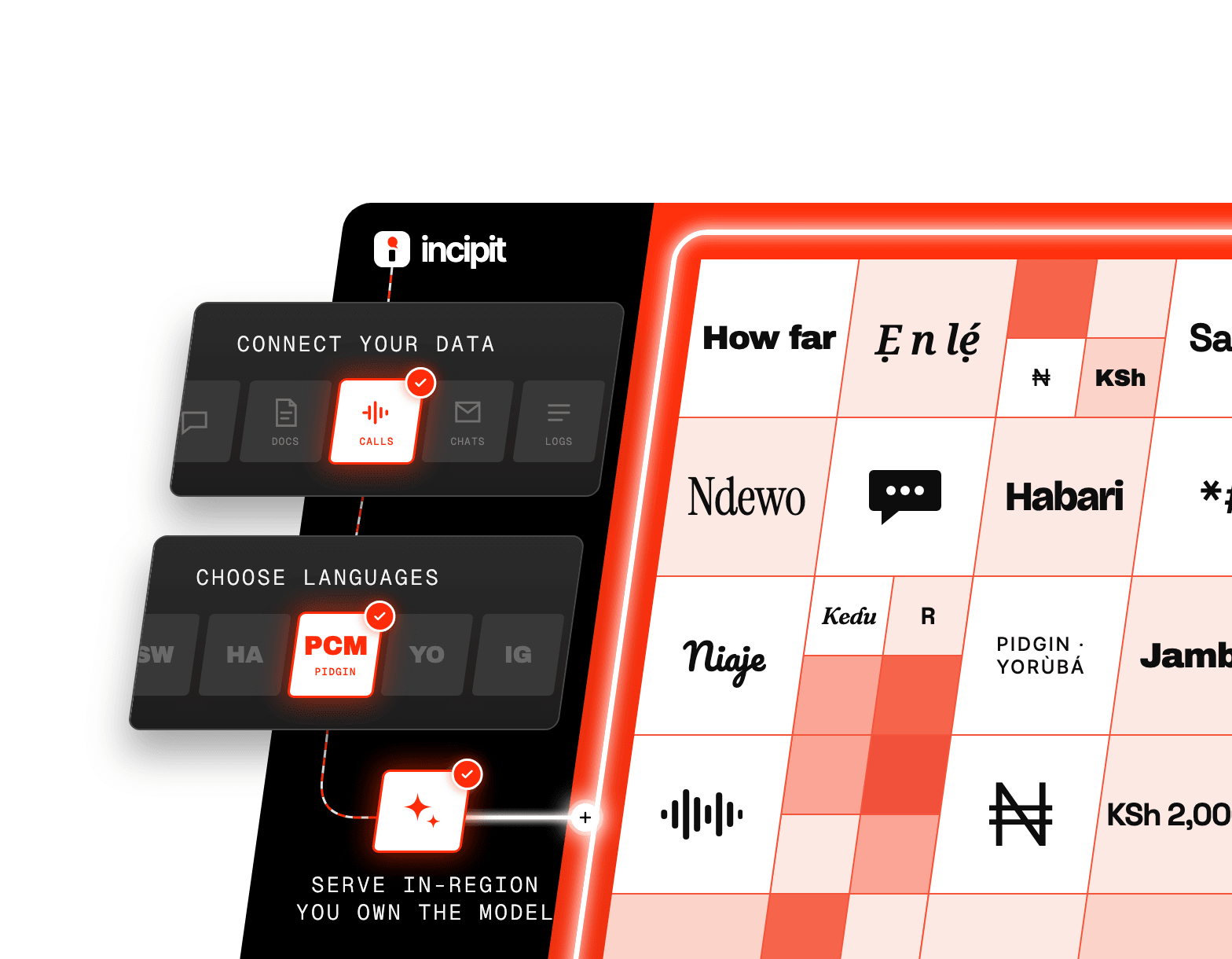
Built for the way your customers actually talk
- How farNigerian Pidgin
- Ẹ n lẹ́Yorùbá
- SannuHausa
- NdewoIgbo
- HabariKiswahili
- NiajeSheng
- ₦ · KSh · RLocal amounts
- *#USSD flows
The problem
General models weren’t trained on your customers.
Same message, two models. One was trained on the open web. The other on a company’s own conversations.
“Abeg, I send 15k to my sister since morning, e never land. Una don debit me twice sef.”Meaning I sent ₦15,000 to my sister this morning and it hasn't arrived. You've also debited me twice.
I'm sorry, I didn't quite understand. Could you please rephrase your question in English?
Asks the customer to switch language
Sorry about that. Your ₦15,000 transfer from 8:42 this morning is still pending, and I can see the second debit. I don open reversal for the extra one. E go land within 24 hours.
- intent
- failed_transfer
- amount
- NGN 15,000
- issue
- duplicate_debit
- language
- pcm + en
Trained on Western English
General models fail on Pidgin, Yorùbá, Hausa, Igbo, Swahili, and English mixed with them in one sentence.
Blind to local context
Naira and shilling amounts, bank and telco names, USSD flows, local names and addresses.
Data can't leave
Many banks, telcos, insurers and public bodies can't send customer data to a foreign API.
No ML team to fix it
Hiring one is out of reach for most African companies.
How it works
Four agents. The work of an ML team.
Each agent handles one stage, from your raw conversations to a model serving live traffic. You see every step and own every result.
01Data curation agent
Turns call recordings, chat threads, documents and logs into a clean training set. It transcribes, normalizes mixed-language text and spellings, labels language and dialect, and removes personal data first.
02Training agent
Fine-tunes an open-weight model on your data, including with reinforcement learning. Every run stays inside a spend cap you set in naira, shillings or rand.
03Evaluation agent
Grades every candidate in your own environment, per language and dialect, before it goes anywhere near your users.
04Serving agent
Delivers the model through an OpenAI- and Anthropic-compatible endpoint, or as weights. It runs in an African region or inside your own infrastructure.
Recipe as a graph
See the plan before anything runs.
Every job is a visible pipeline with named gates. Nothing moves to the next step until every check passes.
Step 01 · Load
Connects to your call recordings, chat exports, documents and logs. Nothing runs until you've seen the plan.
Output: An inventory of your data
- Sources and sizes
- Languages found
- Channels: voice, chat, SMS, USSD
Gated execution
The agent names each gate. Every check must pass before the next step runs.
Checkpoint promotion
Promote a new checkpoint to live traffic without changing your API calls.
Improvement loop
Production conversations are cleaned and fed back in, so the model keeps learning local usage.
Forward-deployed engineers
Engineers work alongside the agents, inside your stack, until the model clears your bar.
Bring a sample of your data. We’ll draft the plan with you on the call.
Book a demoThe evals platformSeparate product
Already have an agent? Test it before your customers do.
Simulated customers call, chat and text your agent the way real ones do. You get a score per language and see exactly what broke between versions.
Simulated user · Lagos
Code-switchesInterruptsSlangSpelling varies
- Sim userHello? Abeg I wan block my card, e don miss since—
- Your agentGood afternoon. I can help you block—
- Sim userEhen, the one wey end with 4471.interrupts
- Your agentDone. The card ending 4471 is blocked. Do you want a replacement sent to your branch?
Checks3/3 passed
- Handles the interruption
- Blocks the right card
- Never asks for the full card number
Score per language
v1.3 v1.4
- Nigerian Pidgin
- Yorùbá
- HausaRegressed
- Igbo
- Kiswahili
- English
By channel
- Voicepassing
- Chatpassing
- SMSpassing
- USSD3 failing
Hausa dropped after the v1.4 prompt change. 6 failing conversations to review.
Simulated users
They code-switch, mispronounce, interrupt, use slang and spell words their own way.
Every channel
Voice, WhatsApp-style chat, SMS and USSD-style menus.
Local environments
Simulated banking apps and mobile money flows for your agent to act in.
Scores and regressions
A score per language and dialect, compared across every version you ship.
Ownership and data residency
Your data stays home. The model is yours.
You own the weights. Run them where your regulator and your customers expect, and keep the same API calls your team already uses.
- Personal data is removed before anything is trained
- Training and serving can stay in an African region
- Or run everything inside your own infrastructure
- New checkpoints go live without changing your code
Honest limits
What to expect, plainly.
- 01
Coverage grows with data
Language coverage depends on how much data exists. We start with the largest languages and add more with each customer.
- 02
Data sets the ceiling
A model is only as good as the data it learns from. That's why curation and evaluation come first.
- 03
NDPA in mind, no certificate
We build with the Nigeria Data Protection Act in mind. We don't claim any certification.
Who it’s for
Built for the teams closest to customers.
Support, collections and fraud agents that understand how your customers actually speak.
- Disputes and reversals in Pidgin
- Collections calls that switch between Hausa and English
- Scam patterns in local-language messages
Voice and USSD assistants that work in the languages your subscribers use.
- Airtime and data questions by voice
- USSD menus that accept how people type
- Plan changes in Swahili and Sheng
Claims and patient-communication agents that get the details right in every language.
- Claims intake from voice notes
- Reminders in the patient's own language
- Policy questions in Yorùbá and English
Workloads that must run in-region, on your own infrastructure.
- Citizen service lines in several languages
- Document processing that never leaves your servers
- Assistants trained on your own records
Test the agent you've built against real-sounding local users before launch.
- Simulated code-switching users before every release
- Regression checks between versions
- WhatsApp-style and USSD-style flows
Work on low-resource African languages with clean data and per-dialect evaluation.
- Curated, labelled sets from your own recordings
- Evaluation per language and dialect
- Weights you own
SDK
Start a job in a few lines.
Point the agents at your data, choose the languages, set a spend cap and approve the plan. Then call your model with the client you already use.
- Python and TypeScript SDK
- OpenAI- and Anthropic-compatible endpoint
- Quickstarts and worked examples
- Forward-deployed engineers in your stack
from incipit import Incipit client = Incipit() # reads INCIPIT_API_KEY job = client.jobs.create( sources=["s3://support-calls/2026/", "./whatsapp-export/"], languages=["pcm", "yo", "en"], spend_cap="NGN 2,500,000", region="af-south-1",) plan = job.plan() # load → prepare → qualify → budget → train → exportprint(plan.gates) # privacy, language_coverage, spend_capjob.approve() # nothing runs before thisWhich languages do you support?
We start with the largest: Nigerian Pidgin, Yorùbá, Hausa, Igbo and Swahili, plus English mixed with any of them. Coverage depends on how much data exists, so it grows with each customer. On the call we'll tell you plainly what your data can support.
Do we need an ML team?
No. The agents handle curation, training, evaluation and serving, and forward-deployed engineers work alongside them in your stack. You'll need someone who knows the task to review what a good answer looks like.
Where does our data go?
Where you choose. Training and serving can run in an African region, such as AWS Cape Town or Azure South Africa North, or inside your own infrastructure. Personal data is removed before anything is used for training.
Who owns the model?
You do. You can download the weights or serve them through our endpoint, and run them in your own infrastructure whenever you want.
What data do we need to start?
Whatever you already have: call recordings, chat threads, support tickets, documents and logs. If there isn't enough for a language, the language coverage gate tells you before anything is trained.
How do you control cost?
Every job has a spend cap you set in naira, shillings or rand. The plan is priced against it before training starts, and every run stays inside it.
Will we have to change our code?
Not if you already call an OpenAI- or Anthropic-style API. You change the base URL and the model name. New checkpoints are promoted behind the same endpoint.
Can we use only the evals platform?
Yes. If you already have an agent, you can test it with simulated users across voice, WhatsApp-style chat, SMS and USSD-style channels without training a model.
Are you certified under the NDPA?
We don't claim any certification. We build with the Nigeria Data Protection Act in mind: personal data is removed before training, and processing can stay in-region or on your own servers.
Which base models do you use?
The agents compare open-weight candidates on your task before training and choose one that fits your quality, speed and cost needs. We'll go through the options on the call.
incipit · it begins
Every model begins with your own words.
Bring a sample of your conversations. We’ll walk you through the plan, the gates and the spend cap.